Unión de Organizaciones Campesinas e Indígenas de Cotacachi
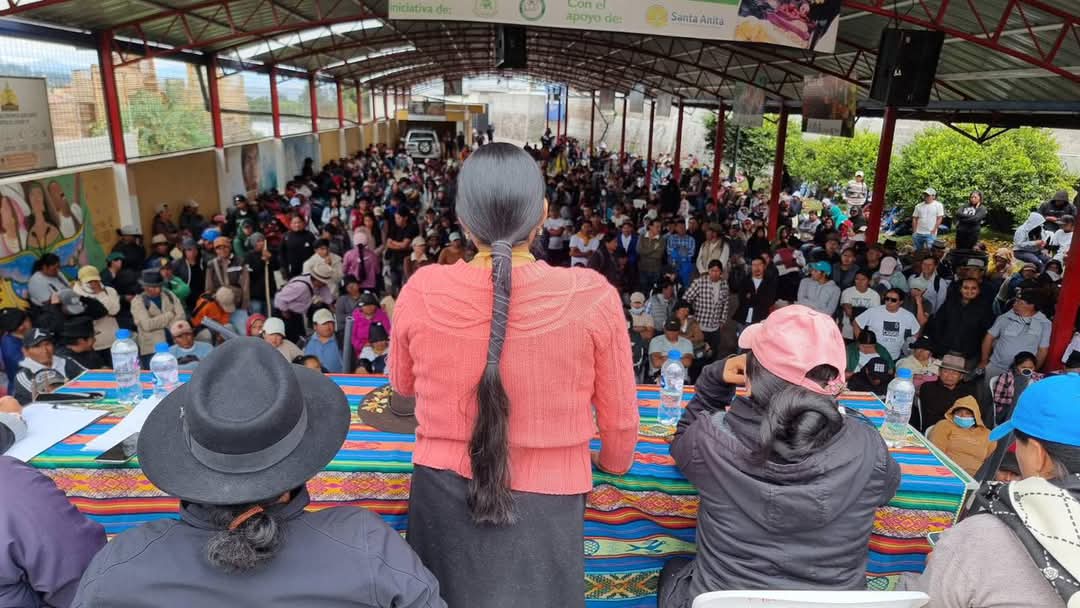
The Unión de Organizaciones Campesinas e Indígenas de Cotacachi -UNORCAC- (Union of Campesino and Indigenous Organisations of Cotacachi) is a non-profit organisation that brings together 48 Kichwa indigenous communities and various grassroots campesino and indigenous organisations in the canton of Cotacachi. It was founded in April 1977 in response to structural conditions of discrimination, exclusion and poverty affecting indigenous communities in Ecuador. In 1980, it obtained legal recognition and is currently part of wider organisational structures such as the Federación Indígena y Campesina de la Provincia de Imbabura -FICAPI- (Indigenous and Campesino Federation of the Province of Imbabura) at the provincial level and the Confederación Nacional de Organizaciones Campesinas, Indígenas, Negras y Montubias – FENOCIN- (National Confederation of Campesino, Indigenous, Black and Montubio Organisations) at the national level.
Its creation is part of an organisational process aimed at defending collective rights, social justice and the dignity of communities. Its mission and work focus on the defence of territory, food sovereignty, Kichwa cultural and linguistic identity, the self-determination of communities, and the protection of nature as a fundamental pillar of its worldview.
Over the course of almost five decades, UNORCAC has led processes to reclaim and defend territory, conserve agro-biodiversity, strengthen the Andean chakra as a way of life (recognised as a Globally Important Agricultural Heritage System – GIAHS), and revitalise the Kichwa language and ancestral knowledge.
They also carry out initiatives to strengthen organisational capacity and defend territory, empower indigenous women, encourage active youth participation, and consolidate community fabric, community-based tourism and the solidarity economy. They promote cultural and community spaces that strengthen identity and social cohesion, such as the Hatun Puncha and the Muyu Raymi Fair, which reaffirm the Andean worldview, agricultural diversity and ancestral knowledge.
In 2023, they were key players in the recognition of the Andean Chakra as part of the Globally Important Agricultural Heritage Systems (GIAHS) by the Food and Agriculture Organisation of the United Nations (FAO), valuing the ancestral production system, its harmonious relationship with nature, and positioning Cotacachi as a key territory for climate resilience and the defence of nature.
In the recent context, the communities organised in UNORCAC face a situation of high social conflict and multiple threats to their territory, including the expansion of monocultures, the intensive use of agrochemicals, the contamination of water sources, pressure from extractive and mining activities, and the loss of productive land. This is added to the criminalisation of indigenous leaders, disinformation campaigns regarding indigenous justice, and repression during social protests, which have left people injured and severely damaged the community fabric.
In this context, UNORCAC positions itself as a strategic actor in promoting sustainable alternatives based on the Andean worldview, climate justice and territorial governance. Its work is based on a solid community organisational framework that brings together social, cultural, political and spiritual dimensions, promoting its own development models focused on good living, the sovereignty of communities and respect for nature.